Here are some simple household tips that may save you some money and aggravation.
1.Remove broken light bulb with potato. (make sure the electric is off)
2.Use Empty toilet paper roll to store appliance cords.
3.Use vertical strokes when washing windows outside and horizontal for inside windows. This way you can tell which side has the streaks. Straight vinegar will get outside windows really clean. Don't wash windows on a sunny day. They will dry quickly and streak.
4.Unclog a sink drain without harmful chemicals, just drop two Alka Seltzer tablets down the drain. Then dump a cup of white vinegar down the drain, allow it to work for about ten minutes, then run the hot water until drain is clear.
5.Spray your favorite perfume on the light bulb in any room to create that scent in the room when the light is turned on.
6.If a wooden door is scraping on its threshold,
Use sandpaper on top of a stack of magazines, just
put the stack of magazines and sandpaper under the open door. Use enough magazines so that the door hits the sandpaper snugly wile working the door back and forth over
the sandpaper.
7.Use Vaseline jelly instead of oil on door hinges. This will keep the drips of oil off of your carpet.
8.A squeaky hardwood floor is usually caused by floorboards
rubbing against each other. By sprinkling talcum powder or liquid wax over the boards and sweeping or rubbing it into the cracks, this will usually take care of the squeaks.
9.When drilling holes into a ceiling, you can avoid an eye full of dust by using an aluminum pie pan with a hole through the center. Hold the pie pan under the area to be drilled, and put the bit through the hole in the pie pan. This way the pan will catch the dust.
10.To remove fresh carpet stains, sprinkle dry cornstarch or baking soda on carpet wait ten minuets and vacuum.
11.You can make homemade furniture polish by combining 1/2 cup lemon juice to 1-cup vegetable oil or olive oil.
12.To loosen a rusty screw, apply a squirt of vinegar or hydrogen peroxide.
13.Keep bathroom mirrors from fogging by waxing them with liquid car wax.
14.Heating the window jams with a hairdryer can loosen old wooden windows that are stuck. Once the window is opened, rub an old candle in the window jams.
Wednesday, May 27, 2009

Tuesday, May 5, 2009
How Long Will This Last? (By Request) Part 2
Here are some tips on how to determine your overall home maintenance plan for the next five to 10 years by knowing the longevity of your home appliances and various components of your home .
APPLIANCES
Clothes dryer 14
Clothes washer 13
Dishwasher 10
Microwave oven 11
Range, electric 17
Range, gas 19
BATHROOM FIXTURES
Cast-iron tub 50
Fiberglass tub/shower 10-15
Toilet 50
COUNTER TOPS
Ceramic 15-25 years
Granite lifetime
laminated 10-15
Wood 20+
DOORS
Exterior, protected by overhang 80-100
Exterior, unprotected and exposed 25-30
Garage door 20-50
Garage-door opener 10
Interior, hollow core 30
Interior, solid core 30 to life
Screen 25-50
FLOORS
Oak or pine lifetime
Slate flagstone lifetime
Vinyl sheet or tile 20-30
HEATERS and AIR CONDITIONERS
Heat Pump and Central Air Conditioner: 15 years
Furnace, gas- or oil-fired 16
Water heater, electric 11-14
Water heater, gas 11-13
LANDSCAPING
Deck, wooden 15
Driveway, asphalt 10
Fence 12
Patio, brick or concrete 24
Walkway, concrete 24
Walkway, gravel 4
ROOFING
Asphalt 15-30
Sheet metal 20-50
Slate 50-100
Tile 50
Wood shingles and shakes 15-35
SIDING
Aluminum 20-50
Metal 50 to life
Vinyl 30
Wood 30-100
According to The HomeTeam Inspection Service/HouseDoctors Handyman Service, in conjunction with the National Association of Home Builders, these numbers represent the maximum number of years you can reasonably expect various components of your home to last. Life expectancy may vary greatly depending on quality of material, installation, maintenance, environmental factors and use.
APPLIANCES
Clothes dryer 14
Clothes washer 13
Dishwasher 10
Microwave oven 11
Range, electric 17
Range, gas 19
BATHROOM FIXTURES
Cast-iron tub 50
Fiberglass tub/shower 10-15
Toilet 50
COUNTER TOPS
Ceramic 15-25 years
Granite lifetime
laminated 10-15
Wood 20+
DOORS
Exterior, protected by overhang 80-100
Exterior, unprotected and exposed 25-30
Garage door 20-50
Garage-door opener 10
Interior, hollow core 30
Interior, solid core 30 to life
Screen 25-50
FLOORS
Oak or pine lifetime
Slate flagstone lifetime
Vinyl sheet or tile 20-30
HEATERS and AIR CONDITIONERS
Heat Pump and Central Air Conditioner: 15 years
Furnace, gas- or oil-fired 16
Water heater, electric 11-14
Water heater, gas 11-13
LANDSCAPING
Deck, wooden 15
Driveway, asphalt 10
Fence 12
Patio, brick or concrete 24
Walkway, concrete 24
Walkway, gravel 4
ROOFING
Asphalt 15-30
Sheet metal 20-50
Slate 50-100
Tile 50
Wood shingles and shakes 15-35
SIDING
Aluminum 20-50
Metal 50 to life
Vinyl 30
Wood 30-100
According to The HomeTeam Inspection Service/HouseDoctors Handyman Service, in conjunction with the National Association of Home Builders, these numbers represent the maximum number of years you can reasonably expect various components of your home to last. Life expectancy may vary greatly depending on quality of material, installation, maintenance, environmental factors and use.
Monday, May 4, 2009
How Long Will This Last? (By Request)
I think that most everybody checks expiration dates on items they purchase from a grocery store, especially if it is a bulk item. Knowing the longevity of your purchase will dictate how you use it. For example; you may not buy a bulk item if your family cannot finish the entire item before the expiration date, that would be a waste of money. The items you buy from a grocery store are small ticket items compared to the purchase of a home, but how many people check the expiration date of their home’s components and appliances? The answer is very few people know the longevity of their home’s components and appliances, unless they have had a handyman work on their house or have had a home inspection. As a homeowner, knowing the longevity of your home’s components and appliances can help you budget for repairs, and help avoid expensive surprises. As a home purchaser, knowing the longevity of the home’s components and appliances can help you make the best deal on your purchase. For example; If you are looking to purchase a home that is fifteen years old, and all components and appliances are original, you can expect to replace the appliances soon and other major components in the next five years. This house may not be for you, if you cannot budget twenty to thirty thousand dollars or more for repairs in the next five years. Or maybe this information can help you negotiate a purchase price that reflects the cost of the anticipated repairs.
Tune in tomorrow for a guide line list of the maximum number of years you can reasonably expect various components and appliances in your home to last.
Tune in tomorrow for a guide line list of the maximum number of years you can reasonably expect various components and appliances in your home to last.
Monday, April 27, 2009
The cleaning went well, and now we can see what repairs need to be done. The next step is to take a mortar sample to our expert (Chub Garrett) for a good match, so we can replace the missing mortar. Missing mortar on walls should be repaired, but it is not as big of a deal as missing mortar on paving. Missing mortar on paving will let water go in the voids and undermine the dirt under the paving, this will cause the bricks to sink and make low spots. The low spots will collect water making the deterioration rapid. The sunken brick will make trip hazards, and should be repaired. Before we start re-pointing we will have to pull up all of the sunken brick and re-lay them.
Take a look at the before and after pictures, and see the big difference!
 Side Wall Before Cleaning

Floor Tile Before Cleaning
 Side wall Before Cleaning
 Steps and Walk Before Cleaning
 Cleaning In Progress

 Walk Before Cleaning

Cleaning In Progress
 Big Difference


 Steps After Cleaning
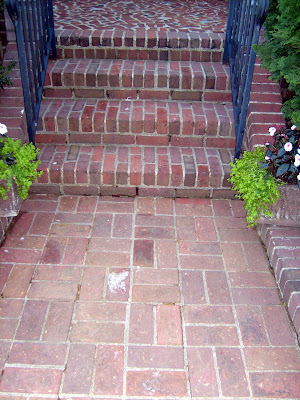 Steps and Walk After Cleaning
 Side Wall After Cleaning
 Now we can see what repairs we need to do

Side Wall After Cleaning
 Steps and Wall After Cleaning
Take a look at the before and after pictures, and see the big difference!
 Years of Car and Bus Exhaust
 Side Wall Before Cleaning
Floor Tile Before Cleaning
 Side wall Before Cleaning
 Steps and Walk Before Cleaning
 Cleaning In Progress
 Walk Before Cleaning
Cleaning In Progress
 Big Difference

 Steps After Cleaning
 Steps and Walk After Cleaning
 Side Wall After Cleaning
 Now we can see what repairs we need to do
Side Wall After Cleaning
 Steps and Wall After Cleaning
Tuesday, April 21, 2009
Masonry Maintenance (Holly's House)
Masonry Maintenance
Normal masonry maintenance consists of cleaning, re-pointing, and sealing. In the case of Holly’s House the masonry has weathered for over eighty years and will need to be thoroughly cleaned and dried before the mortar can be matched for re-pointing. I have found that if you re-point (replace missing mortar) before the masonry is cleaned, you run the risk of a bad mortar color match. With masonry of this age the mortar was mixed with sand from a near by riverbank. The river sand contained a lot of small shell and gravel pieces giving the mortar a rough texture. To keep our re-pointing from looking like a “patch job” the color and the texture need to match the old work as close as possible. Matching old mortar and the general restoration of old masonry is defiantly an art. We are very fortunate to have Norman (Chub) Garrett on our team. Chub has over fifty-six years in the masonry field and was one of only three Masons to receive the “Master Masonry Craftsmanship Award” in Virginia. Chub takes pride in being a living virtuoso of masonry history and restoration. Chub has restored or been the go-to-guy for many historic landmarks in Virginia.
We are going to start cleaning the masonry on the front porch area of the house. As you can see from the pictures below, the masonry has been weathered and stained by mold, car exhaust, and dirt. New masonry requires strong chemicals such as Muriatic Acid to clean mortar off of the masonry surfaces, but in our case there is no mortar on the masonry surface, only dirt, mold, and car exhaust. To remove this dirt, mold, and car exhaust we are going to use a biodegradable soap and a low P.S.I pressure washer.
This will get the job done and keep the plants and flowers safe.


 Let's start the cleaning!
Normal masonry maintenance consists of cleaning, re-pointing, and sealing. In the case of Holly’s House the masonry has weathered for over eighty years and will need to be thoroughly cleaned and dried before the mortar can be matched for re-pointing. I have found that if you re-point (replace missing mortar) before the masonry is cleaned, you run the risk of a bad mortar color match. With masonry of this age the mortar was mixed with sand from a near by riverbank. The river sand contained a lot of small shell and gravel pieces giving the mortar a rough texture. To keep our re-pointing from looking like a “patch job” the color and the texture need to match the old work as close as possible. Matching old mortar and the general restoration of old masonry is defiantly an art. We are very fortunate to have Norman (Chub) Garrett on our team. Chub has over fifty-six years in the masonry field and was one of only three Masons to receive the “Master Masonry Craftsmanship Award” in Virginia. Chub takes pride in being a living virtuoso of masonry history and restoration. Chub has restored or been the go-to-guy for many historic landmarks in Virginia.
We are going to start cleaning the masonry on the front porch area of the house. As you can see from the pictures below, the masonry has been weathered and stained by mold, car exhaust, and dirt. New masonry requires strong chemicals such as Muriatic Acid to clean mortar off of the masonry surfaces, but in our case there is no mortar on the masonry surface, only dirt, mold, and car exhaust. To remove this dirt, mold, and car exhaust we are going to use a biodegradable soap and a low P.S.I pressure washer.
This will get the job done and keep the plants and flowers safe.


 Let's start the cleaning!
See you tomorrow.
Wednesday, April 8, 2009
Chinese Drywall (By Request)
By request: This article was written by request from several readers. Please sent request to agarrett@hometeaminspection.com and put the words “blog request” in the subject box.
Handymen and Home Inspectors are discovering strange odors in some homes built in the past six years. The odor is often described as a rotten egg smell or that of discharged fireworks. The odor is being produced from defective Chinese drywall that has unusually high levels of hydrogen sulphide and ammonia.
Defective Chinese Drywall/Sheetrock is beginning to be Part of a National Investigation, due to reported health issues and rapid corrosive damage to any metal in the home including electrical wiring, plumbing, and HVAC units. There has been a flood of law suits filed or pending and many more to follow.
Chinese drywall:
During the big housing boom in late 2003, a mass quantity of drywall was shipped to the US from China. Chinese drywall has been reported to have unusually high levels of hydrogen sulphide and ammonia that can cause health issues and rapid corrosive damage to any metal in the home including electrical wiring, plumbing, and HVAC units.
Timeline:
Any house built or remolded between 2003 to present.
Where:
According to Americas Watchdog, "we will find the imported toxic Chinese drywall in every US State, with the heaviest concentrations in the US Southeast, the Gulf States, the US Southwest, Texas, the Mountain West, the DC Metro areas & throughout the Western Provinces of Canada. We think there are at least 300,000 new US homes that contain the imported Chinese drywall, & probably 10,000 to 15,000 homes throughout the Western Provinces of Canada."
Problems:
• Possible health issues for the Occupants of the home
• Rapid corrosion of the HVAC unit components
All copper tubing in unit has turned black as a result of being exposed to the high levels of hydrogen sulphide found in the drywall
• Rapid corrosive damage to electrical system
• Exposed ground wire corroded
• Rapid corrosive damage to copper plumbing systems
• Rotten egg or spent firecracker smell in the home
Identification:
Words on the back of the drywall; “CHINA” in red ink or “KNAUF” in black ink, Stamp on the back of the edge tape; C36, if available.
 " KNAUF" ON BACK OF DRYWALL
Inspection Protocol:
Indicators we look for to determine if the house may have Chinese drywall:
• The house was built or remodeled between 2003 to present
• Rotten egg or sulfur-type smell in the home
• Corrosion on air conditioning coils, or HVAC units
• Corroded or black electrical wiring
• Corroded or black copper pipes
• Corroded or tarnished plumbing fixtures
If any of these symptoms are noticeable during the course of your visual inspection, if possible, look at the back of drywall possibly in the attic or garage. Look for the words; “CHINA” in red ink or “KNAUF” in black ink, also look for the Stamp on the back of the edge tape C36.
For more information go to; http://www.doh.state.fl.us/Environment/community/indoor-air/drywall.html
More on Holly’s House tomorrow
Handymen and Home Inspectors are discovering strange odors in some homes built in the past six years. The odor is often described as a rotten egg smell or that of discharged fireworks. The odor is being produced from defective Chinese drywall that has unusually high levels of hydrogen sulphide and ammonia.
Defective Chinese Drywall/Sheetrock is beginning to be Part of a National Investigation, due to reported health issues and rapid corrosive damage to any metal in the home including electrical wiring, plumbing, and HVAC units. There has been a flood of law suits filed or pending and many more to follow.
Chinese drywall:
During the big housing boom in late 2003, a mass quantity of drywall was shipped to the US from China. Chinese drywall has been reported to have unusually high levels of hydrogen sulphide and ammonia that can cause health issues and rapid corrosive damage to any metal in the home including electrical wiring, plumbing, and HVAC units.
Timeline:
Any house built or remolded between 2003 to present.
Where:
According to Americas Watchdog, "we will find the imported toxic Chinese drywall in every US State, with the heaviest concentrations in the US Southeast, the Gulf States, the US Southwest, Texas, the Mountain West, the DC Metro areas & throughout the Western Provinces of Canada. We think there are at least 300,000 new US homes that contain the imported Chinese drywall, & probably 10,000 to 15,000 homes throughout the Western Provinces of Canada."
Problems:
• Possible health issues for the Occupants of the home
• Rapid corrosion of the HVAC unit components
All copper tubing in unit has turned black as a result of being exposed to the high levels of hydrogen sulphide found in the drywall
• Rapid corrosive damage to electrical system
• Exposed ground wire corroded
• Rapid corrosive damage to copper plumbing systems
• Rotten egg or spent firecracker smell in the home
Identification:
Words on the back of the drywall; “CHINA” in red ink or “KNAUF” in black ink, Stamp on the back of the edge tape; C36, if available.
 " KNAUF" ON BACK OF DRYWALL
Inspection Protocol:
Indicators we look for to determine if the house may have Chinese drywall:
• The house was built or remodeled between 2003 to present
• Rotten egg or sulfur-type smell in the home
• Corrosion on air conditioning coils, or HVAC units
• Corroded or black electrical wiring
• Corroded or black copper pipes
• Corroded or tarnished plumbing fixtures
If any of these symptoms are noticeable during the course of your visual inspection, if possible, look at the back of drywall possibly in the attic or garage. Look for the words; “CHINA” in red ink or “KNAUF” in black ink, also look for the Stamp on the back of the edge tape C36.
For more information go to; http://www.doh.state.fl.us/Environment/community/indoor-air/drywall.html
More on Holly’s House tomorrow
Friday, April 3, 2009
Holly's House (Part 12)
For the most part Handymen and Home Inspectors are in a lot of brick homes that are framed with non-supporting brick cladding. The brick you see on the exterior of a brick/framed house offer no structural support, they only give you the feel of a brick house. During the era Holly’s House was built, it was common for brick houses to be constructed of solid masonry (no wood framing). In a solid masonry house the brick act as the main structural support. The bonds (brick pattern) you see was to inter lock the brick walls together to create a strong solid masonry wall. In this era of masonry, common brick (plain smooth red brick) where used on the exterior of the house on walls not visible from the street. On the exterior walls facing the street or streets, a face brick (decorative brick) was used, and usually in a more decorative pattern. On Holly’s House a common brick was used on the back and one side of the house in an American bond (common pattern). A real nice wood mold face brick laid in an Old English bond was used for the front and one side of the house. Other nice features on the face brick sides include brick arches and a round window.
Here are some pictures of the exterior brickwork:
Here are some pictures of the exterior brickwork:

Street Side
 Bull's Eye Window
 Front
Front Side and Rear View
Back View
 Common Brick With an Amercian Bond (on the left) Face Brick With an Old English Bond (on the right)
Subscribe to:
Posts (Atom)